


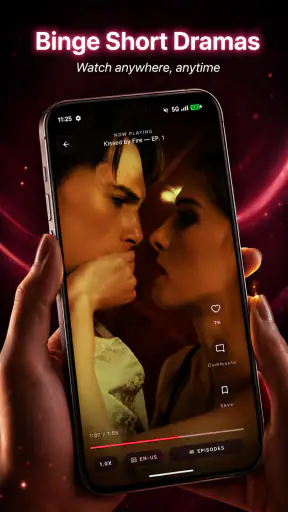
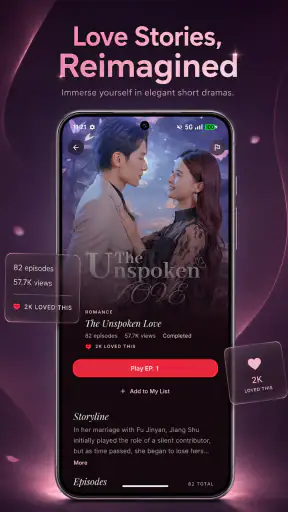
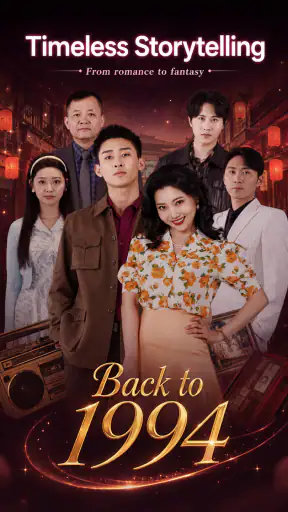
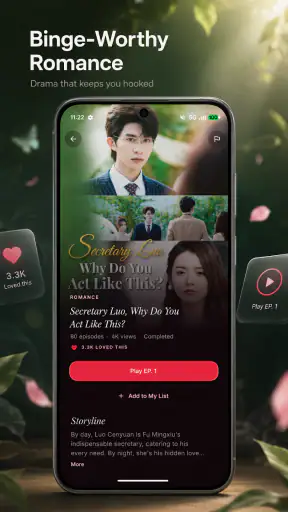
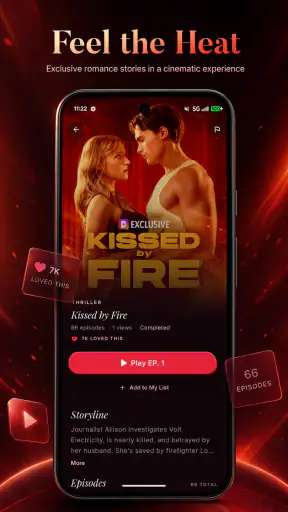
I spent time with DramaKiss as a quick entertainment app built around short romantic drama episodes. Its appeal is easy to understand: instead of committing to a full-length series, I can open it for a few minutes, watch a compact piece of a story, and decide whether I want to continue. That makes it a natural fit for breaks, commutes, or those evenings when I want something light and immediate rather than a long movie.
The app comes from TRANSPORT HOSPITAL GAME and sits in the entertainment category. It is free to install, aimed at Teen users, and supports devices running Android 7.0 or later. The current release is version 1.0.5. Its audience is already substantial, with more than a million installs and an average score of 4.2 from roughly 1.4 thousand ratings. Those figures suggest that the short-form drama format has found a real audience, although they do not replace the question that matters most: whether this particular style of viewing suits you.
How DramaKiss feels during everyday viewing
Fast access is the main attraction
My first impression is that DramaKiss is designed around reducing the effort between opening an app and starting a story. The short-episode format removes much of the planning that comes with traditional streaming. I do not need to remember a long plot before returning, set aside an entire evening, or choose a film that may not match my mood. The basic rhythm is much closer to browsing a stream of dramatic moments and deciding whether the next one deserves my attention.
That makes it particularly convenient when I have a small amount of free time. For example, I might open it while waiting for an appointment, watch part of a romance storyline, and close the app without feeling that I abandoned a major viewing session. Later, I can return when I want a quick emotional hook. This is where the app makes more sense than a conventional television service: its value is not depth per sitting, but immediate access to compact stories.
There is also a psychological advantage to short episodes. A full series can feel like work when I am tired, while a brief dramatic installment feels manageable. The downside is that this same design encourages “just one more” viewing. A cliffhanger arrives before the story has had time to settle, and the natural response is to continue. I found that the app works best when I decide in advance whether I have five minutes or a longer break, rather than opening it without a limit.
What the format does well—and where it becomes repetitive
Short romance dramas need to establish conflict quickly. That can be entertaining when I want clear emotional stakes without a slow introduction. The format is good at delivering a relationship problem, a misunderstanding, or a sudden turn in a compact package. I can understand the immediate tension without studying a large cast or a complicated fictional world.
However, the same compression can make the storytelling feel hurried. Characters may have less room to develop naturally, and dramatic turns can feel more important than believable transitions. Viewers who enjoy carefully paced television, subtle dialogue, or long character arcs may find the experience thin compared with a standard series. I would not choose this app as my only source of drama if I wanted rich world-building or a carefully layered plot.
For me, the strongest use is as a small entertainment habit rather than a replacement for every other streaming option. I can watch a few episodes while taking a break, then switch to a longer service when I want a complete narrative. That distinction matters because the app’s compact format is its identity, not merely a shorter version of conventional television.
How I would organize a casual viewing routine
A useful approach is to treat each session as a small block of time. If I am using the app during a lunch break, I start with enough time to watch a short sequence rather than opening it at the last possible minute. This avoids stopping directly at a dramatic interruption. In the evening, I would rather choose one storyline and remain with it than jump constantly between unrelated clips, because continuity makes the emotional payoff easier to follow.
Another practical habit is to notice how I feel after several episodes. If the stories begin to blur together, that is a sign to pause instead of continuing automatically. Short drama apps are built for easy repetition, but taking a break helps keep the format enjoyable. This is a small point, yet it makes a noticeable difference for anyone who tends to consume episodic content in long stretches.
Heavy-use moments and resource expectations
The most demanding moments are likely to occur when I watch several video episodes in one sitting. Video playback naturally asks more of a phone than reading text or browsing a simple utility, especially when the screen stays active for an extended period. I noticed that the practical concerns are less about launching the app once and more about the cumulative effect of repeated viewing: battery use, mobile data consumption, and available attention all become more important as a session grows.
I would therefore use Wi-Fi for longer viewing whenever possible. That is not a special requirement of the story format; it is simply the sensible choice for any app centered on repeated video playback. If I am away from home, I would keep sessions shorter and check my device’s data controls rather than assuming that a free app means the viewing itself has no cost. The app is free to download, but that should not be confused with unlimited access to a mobile data plan.
Long sessions can also expose the limits of an older phone more clearly than occasional use. A device that handles a quick episode comfortably may feel warmer or lose charge faster after repeated playback. I would not describe that as a fault unique to DramaKiss, but it is part of the ownership experience. The app is better suited to moderate viewing on a well-maintained device than to leaving a long stream running all day.
There is another heavy-use issue that is easy to overlook: attention fatigue. Short episodes are designed to deliver frequent turning points, so a long session can feel more intense than its clock time suggests. I found that alternating between a few episodes and a break gives the stories more impact. If I watch continuously for too long, the dramatic structure becomes predictable and the emotional effect weakens.
Stability, interruptions, and recovering a session
For an app like this, reliability is not only about whether it opens. It is also about whether I can return to a story without unnecessary friction, whether playback remains usable during ordinary viewing, and whether a brief interruption ruins the session. My expectations are fairly simple: I want to open the app, identify what I was watching, and continue without having to reconstruct the entire plot from memory.
Short-form entertainment is especially sensitive to interruptions because each episode may end at a key moment. If a call, notification, or temporary connection problem breaks playback, the experience feels more frustrating than it would in a casual photo app. I recommend treating the app as something to use when the connection and surroundings are reasonably stable, rather than relying on it for an uninterrupted experience in every situation.
When a session is interrupted, my practical recovery method is to return to the same storyline instead of immediately browsing elsewhere. That reduces the chance of losing the emotional thread. I also prefer closing and reopening the app if playback behaves oddly, rather than repeatedly tapping the screen and creating more confusion. These are ordinary recovery steps, but they are useful because short episodes leave less context to help me remember where I was.
The version number alone should not be treated as a promise of flawless performance. Version 1.0.5 indicates the release currently associated with the app, but it does not tell me how every phone, network, or background process will behave. In my view, the right expectation is ordinary mobile-app variability: a smooth session on a compatible device, with the possibility that older hardware, weak connectivity, or long viewing periods may make the experience less comfortable.
Device constraints and age suitability
DramaKiss supports Android 7.0 and newer, which gives it a broad compatibility range. Still, operating-system support is only the starting point. The actual experience depends on the phone’s age, available storage, battery condition, screen quality, and connection. A newer device will generally be a more pleasant place to watch repeated video than an older handset with a tired battery or limited free space.
I would be cautious about installing it on a device that is already struggling with storage or background tasks. Even when an app itself is not unusually demanding, video entertainment becomes less enjoyable if the phone frequently pauses, closes apps, or needs charging. A quick check of free space and battery health is more useful than judging compatibility from the operating-system requirement alone.
The Teen content rating is also important for families. I would not hand the app to a younger child simply because the episodes are short or presented in a colorful, easy-to-browse format. Teen suitability means parents should make their own decision based on the child’s age and maturity. If a shared family device is involved, it is sensible for an adult to explore the available stories first and decide whether the themes fit the intended viewer.
Privacy and spending habits deserve attention as well. The app is free, but in-app purchases range from $2.99 to $54.99 per item. That is a meaningful spread, particularly if a viewer is tempted to unlock more content during a cliffhanger. I would approach the purchase system with a clear personal rule: enjoy the free experience first, understand what an item unlocks, and avoid buying impulsively just to resolve one dramatic moment.
This is one area where the app may not be ideal for children or for anyone who dislikes paid progression in entertainment. A viewer who wants every episode available without interruptions may prefer a subscription service with a predictable payment model, or a platform where the content is already included in one plan. DramaKiss may suit someone who values occasional, bite-sized viewing, but the purchase range makes it worth paying attention to how quickly a casual session can become an expensive habit.
Comparing it with familiar alternatives
Compared with a conventional streaming platform, DramaKiss is more immediate and less demanding in terms of time. A mainstream service is usually better for films, complete seasons, broad genres, and high-production storytelling. It is also often easier to plan a full evening around a known runtime. DramaKiss, by contrast, is strongest when I want a compact romantic storyline and do not want to choose a two-hour commitment.
Compared with social-video apps, it offers a more focused dramatic purpose. Social feeds may provide a wider mix of comedy, news, creators, and random clips, but that variety can make it harder to stay with one narrative. DramaKiss is a better choice when I specifically want romance and short serialized drama. A general video feed is better when I want discovery across many subjects or the ability to follow creators rather than fictional storylines.
Compared with reading a romance novel or web fiction, the app is easier to consume in a few spare minutes and requires less concentration. Reading is often better for imagination, detail, and uninterrupted control over pace. DramaKiss wins on immediacy and visual presentation, while written stories usually offer more room for internal thoughts and gradual development. I would choose between them based on whether I want passive viewing or a more involved reading experience.
The app also differs from short-video platforms in an important way: its appeal depends on continuing a plot. That can be satisfying for viewers who like cliffhangers, but frustrating for anyone who prefers self-contained clips. If I want a complete joke, tip, or visual idea in one swipe, a general short-video service may be a better match. If I want a continuing romance that can be consumed in small pieces, DramaKiss has the clearer purpose.
Who will get the most from it
I think DramaKiss is a good fit for viewers who enjoy romance, frequent plot turns, and flexible sessions. It works well for someone who watches on a phone, has irregular free time, and prefers a story to be available in small portions. It may also appeal to viewers who find full-length series intimidating but still want recurring characters and an ongoing emotional thread.
It is less suitable for people who dislike cliffhangers, want a single complete story in each sitting, or expect the depth and polish of premium long-form television. I would also steer away from it if I were trying to avoid optional purchases entirely. The free entry point is attractive, but the presence of purchases means I would want to manage my expectations and spending from the beginning.
For a family, the Teen rating should be part of the decision rather than an afterthought. For an older phone, I would start with brief sessions and observe how comfortable the device remains. For someone with limited mobile data, Wi-Fi is the practical choice. These details do not make the app difficult to use, but they determine whether its convenience remains convenient in real life.
My performance verdict
DramaKiss succeeds when I judge it by its intended rhythm: open the app, enter a short romantic drama, watch a compact episode, and return later. Its perceived speed comes from how little commitment it asks for, not from any promise that every device or connection will behave identically. During moderate sessions, that lightweight feeling is the app’s biggest strength.
Its weaknesses appear during extended use. Repeated video viewing can place more pressure on battery and data than a simple entertainment browser, and the cliffhanger structure may encourage longer sessions than planned. Older devices and unstable connections are likely to make those weaknesses more noticeable. The in-app purchase range also means that “free” should be understood as free entry, not necessarily a guarantee that every desired viewing path will remain cost-free.
After weighing those trade-offs, I would recommend it to a friend who wants quick romance stories on a phone and enjoys continuing drama in small portions. I would suggest using Wi-Fi for longer sessions, setting a spending limit, and checking the Teen suitability before sharing it with a younger viewer. I would not recommend it as a replacement for a full streaming library or as the best option for someone seeking slow, detailed storytelling.
My final view is positive but specific: DramaKiss is most enjoyable as a convenient short-form drama companion, not as an all-purpose television service. If that distinction matches the way you watch, the app’s free starting point and compact episodes make it easy to try. If you need predictable costs, complete stories, or consistently deep character development, a traditional streaming or reading alternative will probably serve you better.


